Category: Culture

  • CBC is adopting Neo4j

    CBC is adopting Neo4j

    Probably one of the more popular meetups in the Toronto area is the Toronto Data Science Group which regularly boasts a few hundred members at its meetings. I usually don’t sign up quickly enough and have missed out because they are at capacity. Last week, they hosted a meetup at MaRS Discovery District and I managed to get a spot, which was doubly good because it was at my place of work and I could pop down to the auditorium without trekking outside in the cold.

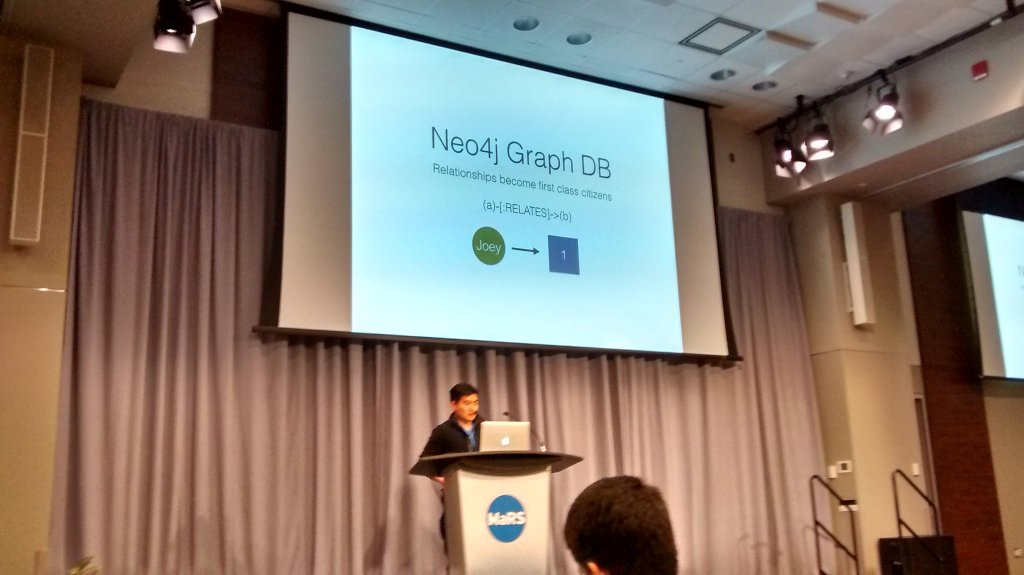
    I’m really glad I managed to make it, because the meetup (hosted by Christopher Berry) consisted of a presentation by Richard Loa of CBC who was showing us a couple of different tools that CBC has adopted. One is to augment their web analytics with Neo4j, a popular graph database and also to present read-js a JavaScript library they have developed to better capture onFocus events than their other web analytics tools currently do.

    Most of this was right up my alley, as in a former life I got into web analytics somewhat, and in particular how broadcasters measure their audience capture. The Canada Media Fund (“CMF”) where I used to work as an analyst was trying their best at the time to figure out how to incorporate “new” media audience in with their reward system. This system, the “Broadcaster Envelope Program” was a major part of the algorithm of how funding was allocated. The CMF had to figure out not only web, but how all media properties were measured was a challenge. I became highly aware of the problems broadcasters face as their business model rapidly changes away from traditional television. While I’ve moved on, I’ve kept up a tangential interest in the media sector.

    The second chord this struck with me was the adoption of Neo4j: I’ve played around with the free version and it is pretty powerful. CBC’s reason for adopting it was that it allows for the ability to traverse a graph and get in deep with understanding the relationships between their customers and their preferences. After the presentation, I felt like they were doing it the right way, by letting their business needs and questions drive them to adopting a graph structure, and not jumping on just because it is a cool tool.

    An added bonus was the inclusion of one guy who actually taught a Neo4j workshop I attended. Whether by accident or design, it was good to see him there, as he weighed in on some of the harder Neo4j questions from audience members.

    Finally, another piece of news is that CBC has developed a JavaScript library that lets it do a more robust job of tracking online readership. They have also done this the right way by putting it on GitHub and inviting contributors to improve the code. I would encourage anyone with the skills and the interest to dive in.

    Want to see more? Here is the link to the slides or check out their next meetup.
  • Charlinarium 20 years later

    Charlinarium 20 years later

    I had a screen printing kit in our studio that was begging to be used, and coincidentally, I also needed to find some activity that competed with the kids tablets. Screenprinting was a good call because the kids had a great time at the Mini Maker Faire this year doing some seriography courtesy of Peach Beserk. So we spent the weekend learning about how to make prints, or in my case re-learning because it had been 20 years since I had done this.

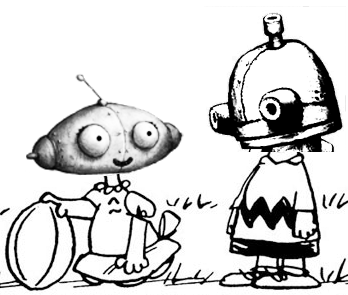
    The kids made a Minecraft creeper shirt and a Lego Batman shirt, respectively. They also helped out my project, which is a mashup of Machinarium and Lucy about to pull the football away from Charlie Brown. Something about the somewhat gormless look on Machinarium’s protagonist’s face made it somehow easy to believe that he would duped into missing the football over and over again.

    Charlinarium t-shirt
    Charlie Brown Machinarium T-Shirt

    Instead of using photo emulsion, I simply plopped the heads on in photoshop, and then traced the outlines using screen filler resist. I didn’t want the image to be too “in your face” on the shirt, so shades of grey and white worked best for me. The result was “Charlinarium”, which will keep me going until if they ever come out with a Machinarium 2.

  • Metallic c-print photography

    In anticipation of the Maker Sale held at my house, I unearthed some metallic c-print photographs I had taken a few years ago before a family and ‘real’ life came along. The photographs are from interesting locations in and around Toronto, including the Distillery District (I had actually won an award at Pikto for ‘The Conversation’ at that time), the Don Valley Parkway trails, the Brickworks and finally my cottage (not in Toronto this time, but Six Mile Lake).

    Metallic c-print photography is a kind of printing on hyper-glossy photosensitive paper. The paper is so glossy that it has a metallic sheen, thus the name. It is not like printing via an ink-jet printer and is not actually metal. The print, while subject to scratches more than other kinds of photography is archival (100+ years) or so I am told.

    In the case of these photographs, many of them were taken with a medium format Mamiya camera and scanned in via a drum scanner and then stitched together with some additional filtering in Photoshop for maximum effect.

    Does this reappearance of these photographs signal a return to photography? Not likely, but every once in awhile it is interesting to look back and see where I once was.

    Awesome Flickr Gallery Error – Invalid API Key (Key has invalid format)

  • Rethinking 300

    In anticipation of the movie “300 – Rise of an Empire” I recently revisited the original 300 movie. There is little argument that it is one of the most artistic and gory takes of ancient Sparta ever made. It is an underdog story where the Spartans, led by King Leonidas (Gerard Butler) fight against impossible odds against the invading Persians, with only their ability as warriors and (spoiler alert) local geography to help them.

    The first time I saw this film, like most of the audience in the theatre I was thrilled and rooted for the outnumbered Spartans. The movie was aspirational, because you end up identifying with the brave, powerful and chiseled warriors who struggle against the invading hordes. The Persians, while great in number, are often deformed, or somehow freakish in appearance, including their pierced and androgynous leader, Xerxes (Rodrigo Santoro). At first glance, it might seem pretty obvious who are the good guys and who are the bad guys.

    This last viewing of it, however, I changed my mind. This did not come to me slowly after reflecting carefully after having seen it, instead it was more of a thunderclap epiphany during the scene where they all chant in unison. At that moment, the light went on, and I suddenly saw the movie in an entirely different light.

    (From Drew’s Script-O-Rama)

    What is your profession?

    I’m a potter, sir.

    And you, Arcadian.
    What is your profession?

    – Sculptor, sir.
    – Sculptor.

    – And you?
    – Blacksmith.

    Spartans! What is your profession?

    …and it is this point that the Spartans reply in perfect unison and I realized they were a society of perfect conformists.

    For a society to unite against an enemy, it helps to have a common set of goals and values so you can move as one to defend yourself. In the case of the Spartans in this story, these values are (in no particular order) strength, bravery and um…more strength. In the case of these Spartans, their common values are so uniformly ingrained into their society they have become a group of űber conformists. This is the moment of the film where I realized that not only this group of warriors are exactly the same, but their entire culture praises a certain, narrow set of values to the point of atrocity. It has gotten to the point where I knew the villains in the story, and they were not Persian.

    Most obvious of all, this is a group that kills a baby if it does not meet their perfect ideals. And we’re rooting for them? Bizarrely, the flag the Spartans raise in their fight is that of ‘freedom’. Freedom to be what, exactly? The freedom to be just like everyone else or get thrown off a cliff, it seems. And here we are cheering them on as if our eyeballs have some sort of Stockholm Syndrome.

    There is a deliberate irony to the hunchbacked Ephialtes (Andrew Tiernan), who betrays the Spartans after being promised riches and women. He is technically Spartan, but according to their custom should not have even lived. Xerxes takes Ephialtes in, and becomes like a hermaphroditic “wing man” who has your best interests at heart, and accepting of all types, regardless of their difference of appearance.

    It behooves the Spartans to defend their territory against invaders, but think about what values they are defending. You might think that we can’t judge by the standards of today: In a brutal, kill or be kill era, pure strength and toughness are prized qualities. Given that the Spartans appear to ultimately lose, I guess by that yardstick, even they fail their own test of strength at the hands of those who they would not have deemed to have lived more than a few days old.